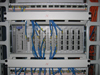
Nexans has installed a complete Plastic Optical Fibre (POF) cabling solution for the headquarters of em2c, a provider of corporate real estate solutions based in Lyon (France). This is the first building in Europe to be equipped with this state-of-the-art technology.

Nexans has installed a complete Plastic Optical Fibre (POF) cabling solution for the headquarters of em2c, a provider of corporate real estate solutions based in Lyon (France). This is the first building in Europe to be equipped with this state-of-the-art technology. The project was conducted in partnership with Nexans cabling solutions activities based in Belgium and the International Nexans Research Center (NRC) located in Lyon.
em2c’s headquarters: a high-tech showcase
The em2c headquarters has a floor space of 3,500sq.m, which will increase further to 5,500sq.m in 2008. The building has been designed as a showroom, and features an open plan concept with meeting points intended to create synergies between the different activities. This friendly building helps customers visualize their projects using the latest technologies such as 3D imaging.
The centralized local area network (LAN) installed by Nexans uses 5km of POF duplex cable and supports both Fast Ethernet and Gigabit Ethernet. Today, the network can connect up to 80 users through FTTD (Fibre To The Desktop) while anticipating the future demand in bandwidth arising from ever-increasing data transmission rates. The active components used are the same as for silica fibre and require no modification.
An alternative to copper and silica fibre solutions
Martin Rossbach, Corporate Project Leader POF, explained: "POF currently provides an attractive alternative to copper and silica fibre solutions with data rates ranging from 100Mbps to 10Gbps. It has already been in use for some time in the automotive industry, and now POF is now becoming of interest to residential and corporate networks with the development of multimedia. Thanks to its capabilities, POF can be used for interconnecting buildings, for high-speed backbone distribution and for horizontal distribution."
An anticipated response to increasing needs
As a promoter of next-generation buildings, em2c wishes to stay at the leading edge of technology, so it was a logical step to select POF. "Our mission is to advise our customers about brand new technologies by showing them the possible applications. em2c regards Plastic Optical Fibre as the information medium of tomorrow… Choosing POF today means that we have future-proofed ourselves by using state-of-the-art technologies to anticipate ever-increasing needs!", said Yvan Patet, CEO of em2c.
Beyond multimedia applications which are getting more and more "speed-intensive", the everyday life of a building will soon also require more information resources. Home automation is gaining ground (with the emergence of new tools for controlling boilers, shutters, lighting etc.) and is now a reality in all kinds of buildings (residential, industrial, corporate). POF is therefore a strategic choice in order to anticipate these new needs.
Easier and quicker to install
Today, although a POF network is still more expensive than a copper network, the total installation costs are significantly lower. POF has proved easier to install due to its higher flexibility and wider cross-section which simplifies connections. Installation is also cheaper than for copper cable, in particular thanks to the total immunity of POF to electromagnetic interference, which makes it possible to use cable paths usually reserved for power cables.
An R&D priority for Nexans
More flexible and stronger than silica fibre, POF is easier to use and will soon be easier to manufacture. This technology is therefore guaranteed a bright future, whether in the automotive, aeronautic or telecommunications industry. POF is especially flexible because it is made from polymer materials. It is unbreakable and most importantly, it does not distort the transmitted light beam. Nexans’ experts predict that POF should find increasing popularity in residential networks and LANs, switchboards, medical imaging, and industrial control. Nexans is backing its faith in POF by investing in a major program aimed at developing this technology.