







-Promo-graphics-(2).png?width=1280)
-Promo-graphics-(1).png?width=800)
Accor Hotels Nederland has an ambitious worldwide sustainability programme called ‘Earth Guest'. Through this programme it aims to achieve savings in key areas like water use, recycling and energy consumption.

FAST FACTS
Client
Accor Hotels
Project
Sofitel Cocagne
Location
Luminaires and controls
Spot LED luminaires
Light sources
MASTERLED, MASTERClassic, Spot LED,
LEDLine, various compact fluorescent lamps
Project Responsable
Eric Senders, Professional Lamps
Background
Accor Hotels Nederland has an ambitious worldwide sustainability programme called ‘Earth Guest'. Through this programme it aims to achieve savings in key areas like water use, recycling and energy consumption. "Lighting is a main area where we can realise substantial savings," said Ron Lemmens, Director of Technical Operations for Accor Hotels Nederland. "In the years to come we want to use 10% less energy globally than in 2006. The partnership with Philips works very well. It is the intention to do the same for all our hotels in the
The Challenge
Lighting plays a major role in determining the ambience of a hotel. "One of the main disadvantages of conventional energy-saving lamps is that the light is too white," says Hans van der Lienden, Facility Manager of Sofitel Cocagne Eindhoven. "What you also see is that the texture of certain fabrics and wood is not properly accentuated." This example shows that any steps taken to reduce the amount of electricity consumed by lamps should therefore not compromise the quality of the light or the atmosphere it creates.
The Solution
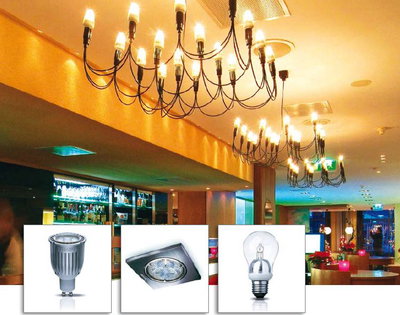
"We have about 4000 lights throughout the hotel, and use for example the Philips MASTERClassic halogen in locations where the ambience is particularly important, like the restaurant and other public areas," says Van der Lienden. "The advantage of halogen is that it gives a warm light and can also be dimmed." "Another example is the waiting area at the lifts, which used to be lit by 35 W spotlights," says Eric Senders, the Philips Hospitality Application Manager for Professional Lamps Europe.
"The same amount of 7 W MASTERLEDs now actually produce more light, while using 80% less energy."
Benefits
Using a combination of halogen, (compact) fluorescent and LED lighting brings a number of advantages. First and foremost, there is the reduction in electricity consumption. "Accor Hotels Nederland uses around €4 million worth of electricity in the
And not only does the new technology achieve energy reductions of as much as 80%, they also last up to 15 times as long as
incandescent lamps, which obviously translates into much lower maintenance and replacement costs. Last benefit is that with some new LED solutions that are used in the lobby now, Sofitel Cocagne is able to adapt their ambience to any occasion with a wide variety of colour combinations!


 JOIN OUR MAILING LIST - KEEP UP TO DATE ON OUR LATEST PRODUCTS

See more from Voltimum on Google
Add Voltimum as a preferred source and Google will show our articles more often in your news results.