











-Promo-graphics-(2).png?width=1280)
-Promo-graphics-(1).png?width=800)
Dealing with air quality and humidity levels in buildings is not confined to older properties. Modern building methods mean that controlled ventilation is no longer a luxury – it is a prerequisite.

Everyone of us exhales 10 to 75 litres of Co2 and up to 175 grams of water per hour. Put another way a family of four produces 10-15 litres of water vapour a day through breathing washing, showering and cooking.
The ability of air to absorb this vapour is dependent on temperature - the warmer the air, the more it can absorb. Extract ventilation can remove water vapour at source. And insulation eliminates cold surfaces on which condensation can form resulting in mould growth.
Traditionally homes were built with less regard to air tightness and had a high level of background air leakage. Whilst expensive to heat, high humidity was to a great extent diluted by ‘drafts’.
Over the last three decades properties have tended to have dimensionally smaller rooms and air leakages have been reduced dramatically. The result is that the same quantity of moisture is being generated by the occupants in a more confined space and with nowhere to go.
Government initiatives to reduce carbon emissions, changes in Building Regulations and public expectations has resulted ‘improved’ properties through amongst other measures insulation, double glazing and low energy appliances.
In ‘tight’ buildings a ventilation strategy is a requisite. Bathrooms and kitchens are warm or hot when in use and can hold water vapour but this quickly migrates to other colder rooms such as bedrooms and will form condensation on cold unventilated surfaces such as the back of wardrobes, corners of ceilings with poor loft insulation or windows with cold bridging. These symptoms occur where relative humidity regularly exceeds 65%. Worse still, warm conditions and an RH of over 60% are the ideal breeding conditions for the house dust mite found in soft furnishings and bedding. Around 80% of asthmatic conditions in the home are said to be triggered by the faeces of the dust mite.
The simplest and most commonly adopted ventilation strategy is to install extract ventilation units as close to the source of the moisture generation in the ‘wet rooms’ of the house - in bathroom/shower rooms, the kitchen and utility area.
A kitchen extract fan such as an Xpelair GX6 can be installed in a wall or window. If a kitchen cooker hood is installed it must be connected via a duct to the outside. Recirculating hoods take out smells but not the humidity. The simplest axial bathroom fans are installed through a window or wall. In high-rise or exposed sites centrifugal fans such as Premier will overcome wind resistance. Combination fans and low energy lamps are also available which can be installed directly over a shower and are ducted to a soffit vent.
In all cases fans are only effective if they are on when needed, so built in automatic humidistat operation negates the need for user intervention. Rooms without windows require the fan to be fitted with an overrun timer. In this situation the fan switches ON with the room light and continues to run for a preset period after the light is switched Off.
Air replacement can be from manually operated slot vents fitted to the headers of widows in bedrooms and the living room.
Alternatively thermostatically operated Autoflow passive air input units can be simply retrofitted to these rooms. Important, but often overlooked, is the need for replacement air to enter toilet, bathroom and kitchen areas when the door is shut; a 10mm gap between the bottom of the door and the floor covering usually suffices.
On major refurbishments two other alternative solutions can be considered: central Mechanical Extract Ventilation (MEV) or wholehouse Mechanical Ventilation with Heat Recovery (MVHR).
Central Extract ventilation uses a multispigot single extract unit with flat or circular ducts drawing air continuously from wet rooms. Because the unit is running continuously much lower extract volumes can be used to effectively combat condensation. MEV fans such as Xvent are available with long life, low energy DC motors minimising energy use. Again air replacement comes from passive ventilators in the living spaces.
Whole house Mechanical Ventilation with Heat Recovery (MVHR) can be considered for properties built or refurbished to current Building Regulations Part F and L standards where air permeability is 8 m3/h at 50pa pressure difference or below.
There are several makes of unit available on the market but in selecting an MVHR unit, it is advisable to check the SAP appendix Q listing of products independently tested by the Building Research Establishment and those shown as Energy Savings Trust ‘best practice compliant’.
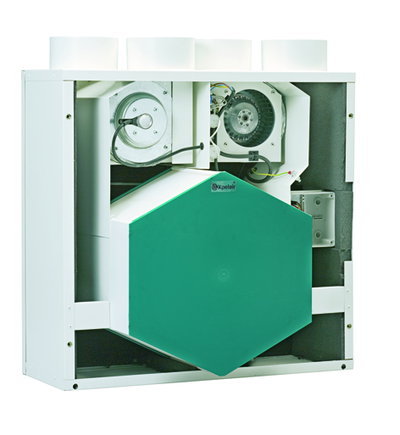
At the heart of the Xcell MVHR unit is a heat recovery cell with a tested heat exchange efficiency of up to 95% ensuring a minimal temperature difference between the outgoing and incoming air.
This system extracts warm moist air via ducting from ‘wet’ rooms (toilets, bathroom utility room and kitchen) and passes this air through a heat recovery cell before it is discharged outside. At the same time fresh air from outside is drawn through the cell in the opposite direction, where it is warmed and distributed to the reception rooms and bedrooms. Xcell 270, which is suitable for detached houses, is fitted with Xpelair Ultra motors -DC technology that provides ultra low energy use and ultra long life backed by a five-year product guarantee.
For cold periods, the unit has a built-in defrost cycle to ensure that the heat recovery cell never freezes and models are available with summer bypass allowing the home owner to take advantage of ‘free cooling’ as evening external temperatures drop below that of the dwelling. The unit is fitted with protective filters and condensate drain and fittings are all included.
On smaller properties and apartments Xcell 150V is more appropriate and compact enough to fit into a kitchen wall cupboard. MVHR systems require no additional passive air replacement.
Although MVHR systems are the most expensive solution, properly specified and installed, they provide the most rapid reduction in humidity, put the least demand on expensive heat and deprive dust mites the conditions in which they can breed. But there is an important quality of air benefit too. Users remark on how much ‘fresher’ their homes feel as the continuous exchange of air even when all the windows are shut all day.
Whichever strategy is being considered it is always best to seek expert advice. Xpelair offers a free CADplan advice service to Builders, Local Authority and Housing Associations to provide cost effective solutions based on specific requirements. Xpelair CADplan can mark up existing architects drawings with the appropriate balanced MVHR system including a full bill of materials as required by Document F.
See more from Voltimum on Google
Add Voltimum as a preferred source and Google will show our articles more often in your news results.